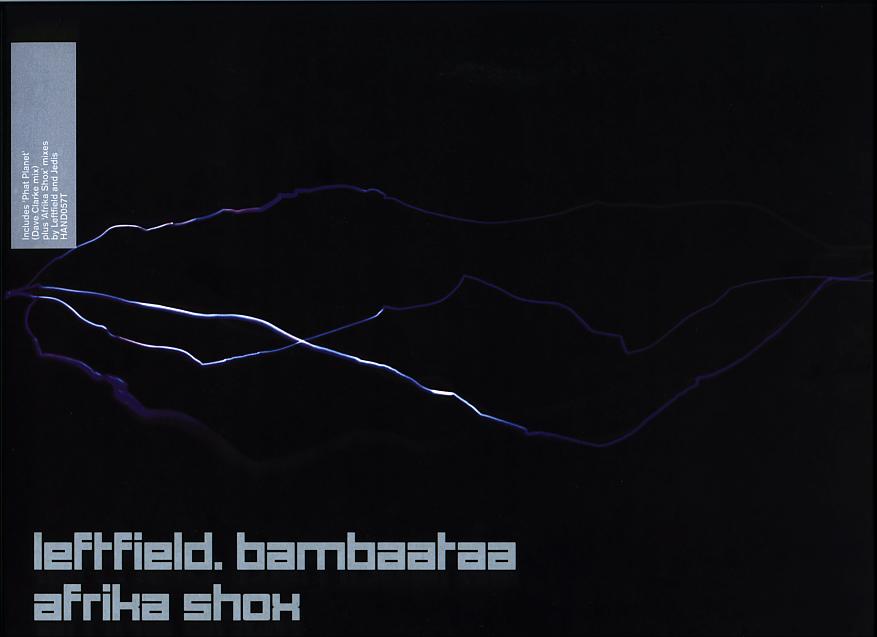
Artist: Leftfield ft. Afrika Bambaataa
Genre: Electronic/ Acid House
Release: 6th September 1999
Music Video Director: Chris Cunningham
Chris Cunningham's interpretation of "Afrika Shox" engulfs us in a dystopian world that appears to be a metaphor for the need of social change; the swift cinematography and darkly lit mise-en-scene not only complement the rather underground, electronic genre of the track, but also Afrika Bambaataa's lyrics. For example, "Are you ready for the new age, they are setting the stage, for the renegades, to control your mind". These lyrics, referring to how the outlaws in society are being prepared for a new age of control; the outlaw being portrayed by the African American veteran "zombie", whereas, the control is most likely to come from the likes of corporate fat cats and government officials. The video therefore amplifies the lyrics, creating an interesting relationship between the music and visuals as it supports and expands on the point the lyrics are trying to make. Therefore, supporting Goodwin's analysis. However, I will go on to expand this point within my analysis, but it's an interesting idea to highlight now; one which Chris Cunningham seems to have grasped and used to shock us about real truths in American society.

The video begins with an establishing shot of a large corporate building, essentially welcoming us in to this dystopian city by giving us a firm idea of where the power lies. Furthermore, the low angle helps further enforce this as it gives the building a form of subjugation; whereby, it's as if the city is constantly being looked over and judged from above. Additionally, the camera movement supports this idea in the way that it slowly pans down from the building, creating a sense of opposition between this corrupt, corporate dystopia and the citizens of the city; a great example of binary opposition, which follows well with in Claude Levis Strauss' narrative theory. The dystopia being portrayed within "Afrika Shox" bares similar reference to psychological thriller, "Pi". Whereby, a mathematical theorist cracks the worlds natural numerical pattern and soon becomes under threat from corporate or other governed power to hand over the digits for their own greed i.e. in stoke analysing. The paranoid protagonist is often compared to an ant, belittled in a large world riddled with corruption. This music video was created for the soundtrack using clips from the film, it showcases a few of the ideas mentioned.


Unfortunately, the classical music can't be heard is it begins just after the video cuts, but
this scene shows the leap in evolution; the discovery of weapons to kill -> reaching and inhabiting outer space.
 |
| Still from "Essex Boys", depicting light bars as a connotation for prison. |
 |
| Still illustrating contrast between protagonist and bagged trash |
alleyway, here, it seems that the individual is being compared to trash, as if this is how blends in with the dystopic society. Considering the character is black, this particular shot and the comparison of trash seems to connote the idea that white people have used the black person for their own good, taking from them and eventually throwing them out when they're not needed anymore.
Furthermore, although white people are depicted as trapped by this oppressive dystopia, black people are even more controlled within this fictional society; this is seen through the white man grasping to a fence in a rather open space, contrasting with the black character within the very confined alleyway. This again, reinforces Claude Levi-Strauss' theory of constant conflict, it also supports the idea of comparing black people to trash within the dystopia; in this creation of conflict, it's as if white people are the trash that is left to the streets, they are disregarded and in a sense controlled. However, the black people are representative of the bagged rubbish, they are even so more confined and subjugated within Cunningham's representation of dystopic New York.

Camerawork and movement depict the confusion of the protagonist, indicating his anxiety and signifying the chaos around him. For example, tight close-ups on the protagonist are performed out of focus to perhaps indicate that the character is out of touch with reality, he's distant from the world he is surrounded by and the focus again perhaps suggests he is not accepted by it. Additionally, handheld camera movement suggests confusion and panic inflicted by the protagonists surroundings.

This sequence gives a solid visual representation of binary opposition between ethnic groups, further demonstrating the divide between white and black people within the dystopic society. We see the protagonist reach out for help from the white business man once they exchange eye contact , the business man simply ignores the black character and continues reading his paper. Moreover, shot-reverse-shot is used to highlight this binary opposition between races; creating conflict by flipping between the two opposing characters. This opposition supports Claude Levis Strauss' theory conceptually and visually, editing creates visual conflict between the two characters; whereas, the different ethnicity of each character drives the conceptual ideas of conflict. In a metaphorical sense, this sequence could be connoting how African-American's are looking for help to get their culture back from the white man; as if their identity is deteriorating as the white man is taking literally everything from them (this idea is supported again further on in the video).
Additionally, we see the protagonist being introduced as a sort of fragile zombie at this point; this is as whilst reaching out for help his arm is knocked off by a passer by, who is also interestingly a white business man. Moreover, the visual portrayal of the protagonist's arm literally shattering off on to the pavement could perhaps be a connotation of how society is hard on it's black population, literally crumbling it's citizens. For example, it is no secret that black people are twice as likely to be stopped and searched, even harassed by the police as opposed to other ethnic groups. Furthermore, the protagonist is also wearing dog tags, giving us an indication that he has been to war, in particular Vietnam; many soldiers returning from the war were disrespected and shamed within society, a fair few being subject to being spat on by the public. This neglect for those fighting for their country is another aspect of representation of specific groups that Cunningham could be portraying within "Afrika Shox".
The link below supports ideas of disrespect and neglect for soldiers fighting in Vietnam.
http://www.startribune.com/opinion/commentaries/160444095.html

In terms of mise-en-scene, chiaroscuro lighting is used during this scene, this is indicated by the light reflections off of the wet road; moreover, paying homage to noir films, such as "Once Upon A Time In America" and "The Third Man". Additionally, the setting of this sequence is very reflective of the music; the underground car park holds connotations to underground music i.e. genres of music that operate outside of mainstream culture, in this case the electronic genre. Furthermore, one of the white break-dancers ends up destroying the protagonists leg with no remorse; this crumbling of body parts references earlier when his hand was destroyed by a white business man, also showing no remorse. This again supports the idea that our white society is literally crumbling black citizens, and each loss of the protagonist's limb is a sign of ignorance towards their culture.


Your case study is very interesting, I'll assess over the next few days but first impressions indicate Level 4.
ReplyDeleteAnother reference to Clint Mansell's music video is to Kafka's iconic short novel "Metamorphosis" where the protagonist wakes up one morning having been transformed into a beetle. The images in the music video remind me of the images in this music video. The notion of alienation in this music video and Africa Shox also suggests Camus' "The Stranger".
A detailed analysis of the way Chris Cunningham has represented New York as a dystopia. As you say in the last paragraph referencing Barthe's theory of narrative, there are many layer of meaning that can be accessed in this music video for example as you have explained the use of binary opposites to raise the spectre of racism.
ReplyDeleteWell done for identifying the connotations of the dog tag and the contempt for the veterans of the Vietnam War. Indeed the shots of the break dancers indicates the colonisation of black music by white artists which is an historical aspect of the music industry.
There are opportunities to reference genre theory in this music video, particularly with the continual references to electronica, with the police lights, and the old tramp clinging to the barbed wire over the lyrics of "let's get electrified" - in this context the wire fence easily exchangeable for an electric fence!
Try to remember Adam, "reinforced" Not "enforced".
It would be a good idea to change the heading to Applying the theory of narrative to "Africa Shox".
Well done Adam - some appropriate inter textual references strengthen this interesting and well researched case study.