Additionally, portraying how Britain wasn't ready or able to pull off American hip-hop and so digressed to the use of instrumental tracks as a progression of the genre in a completely different manner. This idea is summed up best in a quote from an article reviewing the first article to use the term "trip-hop" in order to describe a genre - "The notion of Hip hop without lyrics was a green light to producers worldwide to crack on without worrying about finding a convincing rapper - handy in the UK where we're tired of bad imitations of the Bronx".
A video of Craig Campbell (DJ Kool Herc) describing how he developed the break-beat genre.
Furthermore, trip-hop originated from Bristol, a city which contained one of the most important ports during the Atlantic slave trade and is known today as one of Britain's more racially diverse cities. Therefore, again showing how Caribbean ancestry has brought about a heavy influence on the formation of new genres through recent times. Henceforward, DJ's, MCs, break-dancers and graffiti artists in Bristol formed informal sound-systems i.e. a collaboration of performing DJ's and engineers providing parties within public spaces; often, these sound-systems performed in economically deprived council estates (where most members originated from). As a result, Bristol's sound-system DJ's typically used aspects of Jamaican dub music in order to form a rather "down tempo" beat; alternatively, similar crews had been forming in the Bronx beforehand (instead playing and innovating hip-hop) such as Afrika Bambataa and Grandmaster Flash, both of which were influenced by DJ Kool Herc. Again, showing this developing variation between genres in Bristol and the Bronx.
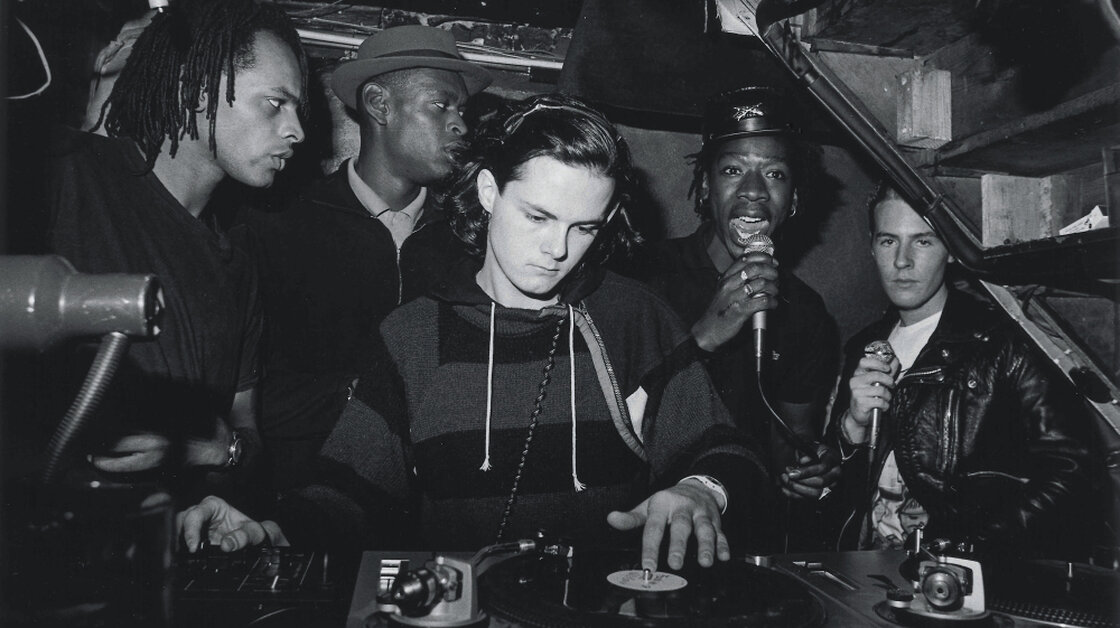 |
| The Wild Bunch, performing at the Dug Out Club in Bristol. |
A track by The Wild Bunch, before they became Massive Attack. The song has been labelled as the beginning of the trip-hop genre.
Moving on, the mainstream globalisation of trip-hop came about in the 1990's; firstly marked by the release of "Blue Lines", Massive Attack's first album. This album was hugely successful, marking a major development of the British hip-hop movement, although the most popular tracks were heavily sample-based e.g. "Unfinished Symphony". Therefore, showing the appeal for this newly found genre and allowing for the influence on other artists to produce tracks via the use of sampling older songs. However, despite their role in the development of the genre, trip-hop was first used to describe one of DJ Shadow's first singles, "In/Flux", in a Mixmag article from 1994. DJ Shadow (Joshua Davis) is an American DJ, widely known for his role in the development of instrumental hip-hop; Davis' record collection exceeds over 60,000, allowing him to break down rare, mainly unheard pieces of music, collating them in to full length tracks. His manipulation of samples is a skill that has built his reputation and managed to cement him as a key figure within early trip-hop.
Moreover, from The Wild Bunch to the first use of trip-hop in music journalism, the genre has been growing and is still evolving in to new styles of music to this date. Whereby, artists from other genres such as Gorrilaz, Beck and Radiohead have all been influenced by trip-hop, showing how one man has essentially inspired and created entire generations of popular artists. Consequently, DJ Kool Herc (Craig Campbell) is a prime example of how Caribbean culture has played a huge part in the evolution of not only the UK, but global music industry; in a way, showing how white people have plagiarised Caribbean culture by adapting it and making it their own. This idea has been portrayed in modern music videos such as "Afrika Shox", a song by Leftfield and Afrika Bambataa, in a scene where white males are breakdancing as a black man crumbles to the floor whilst watching them. Interestingly enough, Afrika Bambataa was in one of the pioneering Bronx crews that inspired the Bristol sound-systems, perhaps showing that there is a link between the portrayal of black people in "Afrika Shox" and the originations of trip-hop.
How does the band we're using for a music video fit within the trip-hop genre?
After listening to the majority of Fold's tracks and reading up on reviews written about the band, as well as how the band see's themselves, I can make a few judgements about how and where they fit in to the trip-hop genre. Firstly, they seem to stick to the traditions of the genre via the use of very down-tempo beats and ambient sounds; aspects of electronica are also present in the majority of their tracks, in this sense giving them a divine similarity to DJ Shadow, bordering on the line of instrumental hip-hop. However, the most interesting thing about Fold's music is that they use samples of political speeches or messages in order to give depth to their tracks; for example, "Mr President, We're in Trouble" contains a sample of Jimmy Carter's "Confidence of Crisis" speech, which delves in to consumerism as one of the main problems we face.
Furthermore, it seems that Fold have created their own image, whilst staying true to the early roots of trip-hop; they've used samples, much like DJ Shadow, but instead actually conveying powerful messages. Additionally, they haven't branched out of the genre like Radiohead, who sync trip-hop with their own vocals to preach about issues, but instead incorporate samples to do the talking for themselves. As if to say, it's been said before, take it in and listen again. Moreover, they could be notifying that the speakers from their samples were heard at the time, but not much has changed or we are digressing back from a state of change. Therefore, with the need to remind us within their tracks.

A confident, intelligent and interesting post indicating effective independent research and your ability to link aspects of genre to specific artists and texts.
ReplyDeleteAt the highest level Adam and a pleasure to read.
Could you add the sources of your research in order to further strengthen.
I am looking through your blog to find your case study on Africa Shox and narrative theory - this does not seem to have been submitted. If not could you please upload within the next week.
ReplyDelete